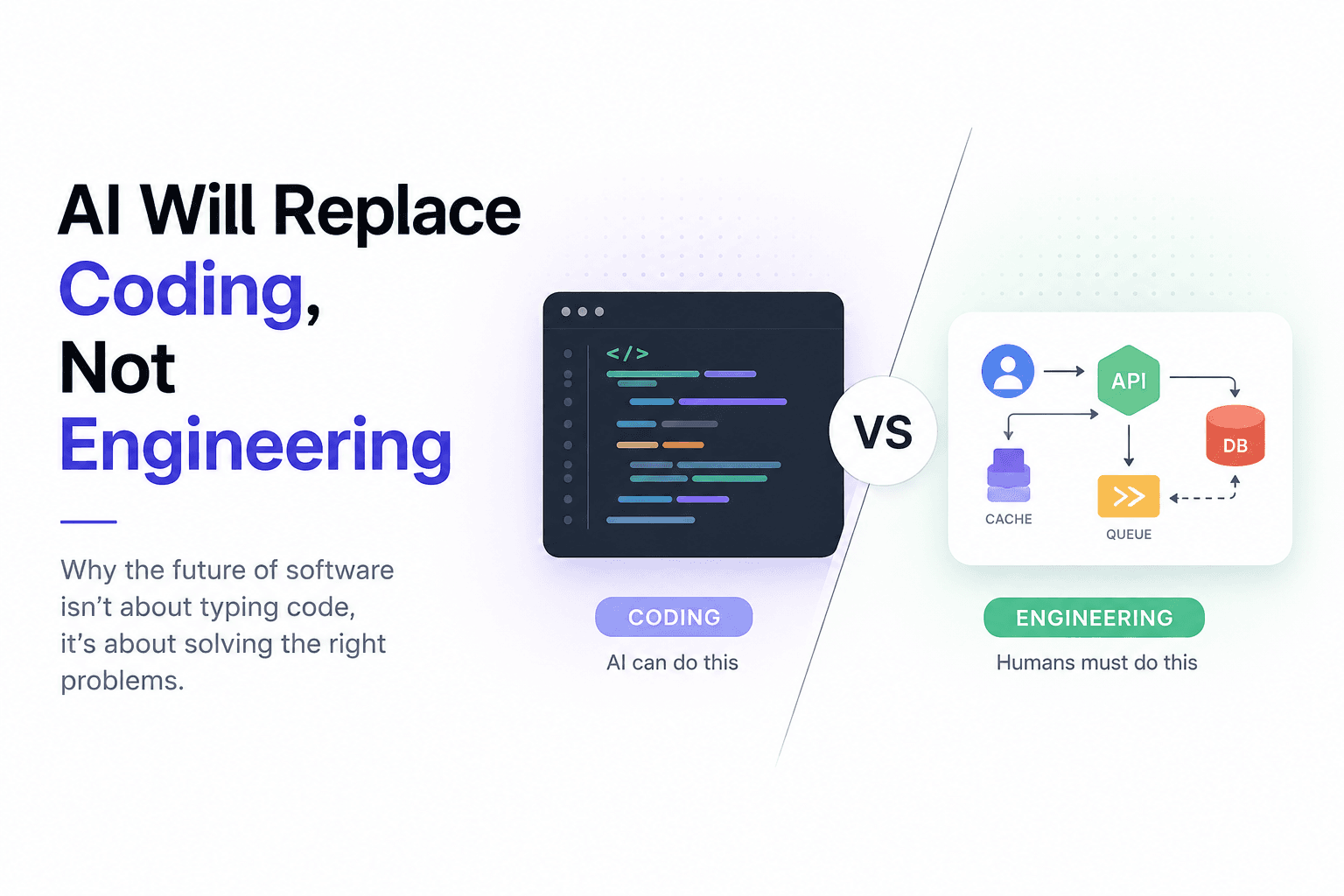
AI Will Replace Coding, But Not Engineering
My personal perspective on how AI is changing the role of software engineers.
Disclaimer: This article represents only my personal views and opinions. It is not intended to criticize, disrespect, or hurt any individual, developer, company, or profession.
For a long time, many people have associated software engineering primarily with writing code.
A software engineer receives requirements, opens an editor, writes code, tests it, fixes bugs, and ships the application.
But I believe AI is changing this model fundamentally.
AI can now generate code dramatically faster than a human. Tools such as AI coding agents can write, modify, refactor, debug, and even test large amounts of code in a very short time.
So the important question is no longer:
"Who can write code faster?"
The more important question is:
"Who can make the right engineering decisions?"
That is where I believe software engineering is heading.
Coding Is Only One Part of Software Engineering
Writing code has always been an important part of software engineering.
But I don't believe coding itself represents the entire engineering discipline.
Consider a typical situation.
A client approaches a freelancer, agency, or software company and says:
"I want to build an e-commerce platform."
That requirement does not tell us how the system should actually be built.
An experienced engineer has to start asking questions.
- What exactly are we building?
- Who are the users?
- What scale should the system support?
- What are the functional requirements?
- What are the non-functional requirements?
- What technology should we use?
- How should the system be structured?
- What data needs to be stored?
- Which database is appropriate?
- Do we need caching?
- Do we need a message broker?
- How should APIs be designed?
- How should authentication work?
- How should the system scale?
- What infrastructure should we use?
- What happens when traffic increases?
- How do we make the system maintainable?
These are engineering problems.
The code is only one part of solving them.
The Engineering Decisions Behind an E-Commerce System
Let's take a simple e-commerce platform as an example.
Suppose we need to build the storefront and an administration system.
An architect or senior engineer might decide that the customer-facing e-commerce application should use Next.js.
Why?
Potentially because the storefront requires SEO, server-side rendering, caching strategies, performance optimization, and good user experience.
For the internal administration panel, the requirements may be completely different.
The team might choose React with Vite, because an internal admin application may not require the same SEO characteristics as a public storefront.
For the backend, the team could consider technologies such as Node.js with Express or NestJS.
Again, this isn't simply about choosing a popular framework.
The decision should be based on requirements such as:
- maintainability
- team expertise
- scalability
- architecture
- development speed
- ecosystem
- operational complexity
- long-term ownership
Then comes the database decision.
What data do we actually have?
Products.
Customers.
Orders.
Payments.
Inventory.
Shipping.
Categories.
Reviews.
Promotions.
Transactions.
Relationships between these entities.
Now we have another engineering question:
Should the system use SQL, NoSQL, or a combination of both?
There isn't one universal answer.
The correct decision depends on the requirements and access patterns.
Then we may ask:
Do we need Redis?
If we need caching, sessions, rate limiting, distributed locks, or high-speed temporary data, Redis might become part of the architecture.
Then another question appears:
Do we need Kafka or another messaging system?
If the system contains asynchronous workflows such as order processing, notifications, inventory events, analytics pipelines, or event-driven communication, a message broker might make sense.
Then we need to think about infrastructure.
Where will the application run?
How will it scale?
How will deployments work?
How will logs be collected?
How will monitoring work?
How will failures be handled?
How will backups work?
How will APIs communicate?
How will authentication and authorization work?
How will the system behave when traffic increases from 1,000 users to 1 million users?
These decisions are not simply "coding."
They are engineering.
AI Can Write the Code
This is where I think the software industry is entering a very interesting phase.
AI can already generate significant amounts of application code.
Instead of spending hours manually typing a feature, an engineer can describe the requirement to an AI coding agent and allow it to implement the first version.
The AI can create:
- API endpoints
- database models
- frontend components
- validation
- tests
- documentation
- configuration
- integrations
- refactoring
- boilerplate
- repetitive business logic
And it can do this extremely quickly.
A human might spend hours implementing something manually.
An AI agent can potentially produce a first implementation in minutes.
That changes the economics of software development.
But there is an important distinction:
Generating code is not the same as engineering a system.
The Role of the Engineer Is Changing
In the traditional development model, a senior engineer might design the system and then distribute implementation tasks to junior developers.
For example:
"You build the authentication module."
"You build the product API."
"You implement the checkout page."
"You create the database models."
The senior engineer spends significant time coordinating implementation.
But AI changes this workflow.
Now the engineer can potentially act more like a technical director.
The engineer defines the architecture.
The engineer defines the constraints.
The engineer provides implementation instructions.
The AI generates the implementation.
The engineer reviews the result.
If something is wrong, the engineer identifies the problem and provides better instructions.
The cycle becomes:
Human → Architecture → Instruction → AI Implementation → Human Review → Refinement
This is a very different development model.
AI Becomes More Like a Junior Engineer
One way I personally think about AI coding agents is this:
AI can become an extremely fast junior engineer.
Not because AI is necessarily "junior" in intelligence, but because the human engineer still needs to provide direction, constraints, context, and ownership.
Imagine saying:
"Build an order-processing service."
That instruction is not enough for a production system.
A good engineer might instead define:
- service boundaries
- API contracts
- database schema
- consistency requirements
- transaction boundaries
- failure scenarios
- retry strategy
- idempotency requirements
- authentication requirements
- authorization rules
- caching requirements
- observability requirements
- performance expectations
- scalability requirements
Now AI has a much better engineering specification to implement.
The quality of the output becomes heavily dependent on the quality of the engineering direction.
Sometimes AI Will Make Better Decisions
I also don't believe the future is simply:
Human makes every decision → AI writes everything.
AI can also be extremely useful for engineering decisions.
An engineer can ask AI:
"Compare PostgreSQL and MongoDB for this workload."
Or:
"What are the scalability risks in this architecture?"
Or:
"Review this API design and identify bottlenecks."
Or:
"Find potential race conditions in this implementation."
Or:
"Suggest an architecture for processing 100,000 events per second."
AI can analyze large amounts of information quickly and provide alternatives that a human engineer may not have considered.
The engineer can then evaluate those suggestions.
So I see AI less as a replacement for engineering judgment and more as a powerful engineering collaborator.
Sometimes the AI may even produce the better idea.
But the engineer still needs to understand why that idea is better and whether it actually fits the system.
The Biggest Change: Less Typing, More Thinking
I think one of the biggest changes AI brings to software development is the reduction of manual typing.
Typing code is time-consuming.
If a machine can generate a significant percentage of the implementation, spending most of our working hours manually typing code may no longer make sense.
That doesn't make coding irrelevant.
It changes its position in the workflow.
Instead of spending 80% of our time writing code and 20% thinking about the system, the balance could move toward:
More thinking. More architecture. More system design. More problem solving. More reviewing. More debugging. More decision making.
The engineer becomes responsible for the quality of the solution rather than simply the quantity of code produced.
What Happens to Junior Developers?
This is probably one of the hardest questions created by AI.
Traditionally, many engineers entered the industry through implementation-heavy work.
They learned by building CRUD APIs.
They implemented small features.
They fixed bugs.
They created UI components.
They wrote database queries.
Over time, they gained enough experience to understand larger systems.
But if AI can perform much of this implementation work, companies may increasingly expect engineers to demonstrate stronger engineering fundamentals earlier in their careers.
That means learning only how to use a framework may not be enough.
Understanding why the framework is being used becomes more important.
Understanding databases becomes more important.
Understanding networking becomes more important.
Understanding distributed systems becomes more important.
Understanding operating systems, concurrency, APIs, caching, consistency, scalability, security, and system design becomes more valuable.
AI Coding Tools Are Excellent for MVPs
Tools such as Lovable and Replit are extremely useful for quickly testing an idea.
If someone wants to validate a product concept, create a prototype, or build an MVP, these tools can dramatically reduce development time.
That's a huge advantage.
But I don't think:
"AI can build an application"
automatically means:
"AI has solved software engineering."
There is a major difference between creating something that works and creating a system that is:
- scalable
- secure
- maintainable
- observable
- reliable
- cost-efficient
- testable
- extensible
- resilient
A prototype may work perfectly with 100 users.
The engineering challenge begins when the system needs to support millions of users, complex workflows, high availability, strict security requirements, and continuous change.
Production Engineering Is a Different Problem
Building a feature is one problem.
Building a production system is another.
For example, an AI can generate an API that successfully creates an order.
But a production engineer needs to ask:
What happens if the client sends the request twice?
What happens if the payment succeeds but the order database transaction fails?
What happens if two requests update the same inventory simultaneously?
What happens if the downstream payment service is unavailable?
Should we retry?
How many times?
Could retries create duplicate payments?
Do we need idempotency keys?
What happens during a database failover?
How do we monitor failed orders?
How do we trace a request across multiple services?
How do we recover from partial failures?
These questions are where engineering depth matters.
The AI can help answer them.
It can generate implementations.
It can suggest solutions.
But someone needs to understand the system well enough to determine whether those solutions are actually correct.
The Engineer of the Future
Because of this, I believe the definition of a software engineer will gradually change.
The engineer of the future may spend less time writing every line manually and more time doing things like:
Problem → Requirements → Architecture → Design → Constraints → AI Implementation → Review → Testing → Optimization → Production
The valuable skill won't simply be:
"I can write code."
It will increasingly be:
"I can take a complex problem and design an effective technical solution."
That is a much deeper skill.
Learn the Fundamentals
If AI is going to write more and more code, I think engineers should go deeper into fundamentals.
Learn:
- Data structures and algorithms
- Databases
- Networking
- Operating systems
- Distributed systems
- Concurrency
- System design
- Software architecture
- API design
- Security
- Scalability
- Caching
- Message queues
- Observability
- Cloud infrastructure
- Reliability engineering
- Performance engineering
And most importantly:
Learn how to make engineering trade-offs.
Because real systems rarely have a perfect solution.
Engineering is often about choosing the best solution under constraints.
AI May Replace a Lot of Coding
My prediction is not that AI will eliminate software engineers.
My prediction is that AI will eliminate a significant amount of manual coding work.
In the next decade, I believe a large percentage of application code could be generated by AI.
The amount of code humans personally type may decrease dramatically.
But the need for people who can understand problems, design systems, evaluate trade-offs, validate AI-generated implementations, and take responsibility for production systems will remain.
Maybe the industry will eventually have fewer people whose primary value is simply writing code.
But I believe there will be enormous value in engineers who can consistently answer:
"What should we build?"
"Why should we build it this way?"
"Will it scale?"
"What can go wrong?"
"What are the trade-offs?"
"How do we make it maintainable?"
"How do we know this solution is actually correct?"
Conclusion
AI is changing software development.
I don't think we should be afraid of that change.
We should understand it.
Coding is an important part of software engineering, but it has never been the whole discipline.
AI can generate code.
AI can generate code extremely quickly.
AI can sometimes generate better code than a human's first attempt.
But software engineering is much bigger than code.
Real engineering is about taking a problem and finding the right solution.
The engineer's role is moving from "person who writes the code" toward "person who designs, directs, evaluates, and owns the solution."
So I believe the engineers who will thrive in this new era won't be the people who simply know how to type code the fastest.
They will be the people who understand systems deeply enough to tell AI what should be built, how it should be built, why it should be built that way, and whether the final result is actually good.
Maybe the future is not:
AI vs Software Engineers.
Maybe it is:
AI writes the code. Engineers do the engineering.
And perhaps the biggest advantage of AI is not that it removes software engineering.
It gives engineers more time to actually do it.