Zuvany
Zuvany — AI-powered customer support and sales platform that helps businesses automate conversations, qualify leads, and engage customers using intelligent AI assistants.
Zuvany — AI Website Assistant Platform
Zuvany is an AI-powered website assistant platform designed to help businesses turn their website into an intelligent, conversational interface.
The platform allows businesses to train an AI assistant using their own website content, PDFs, text, and business knowledge. The assistant can answer customer questions, collect leads, book meetings, execute business workflows, and provide conversational analytics through an embeddable chatbot.
I designed and developed Zuvany end-to-end, covering the frontend, backend, AI pipeline, data processing, integrations, infrastructure, and real-time conversational experience.
What I Built
Zuvany is built around a simple idea:
Give a business its own AI assistant that understands its data, interacts naturally with customers, and can take actions instead of only answering questions.
The platform provides:
- AI-powered website chatbot
- Website and document-based AI training
- Automated website crawling and content extraction
- RAG-based knowledge retrieval
- Lead collection through conversations
- Meeting booking
- AI action workflows
- Multilingual conversations
- Fully customizable chatbot widget
- Shareable AI assistant links
- All-in-one conversation inbox
- Conversation and usage analytics
- Automatic identification of unanswered questions
- Continuous/manual knowledge improvement
- CDN-based website integration
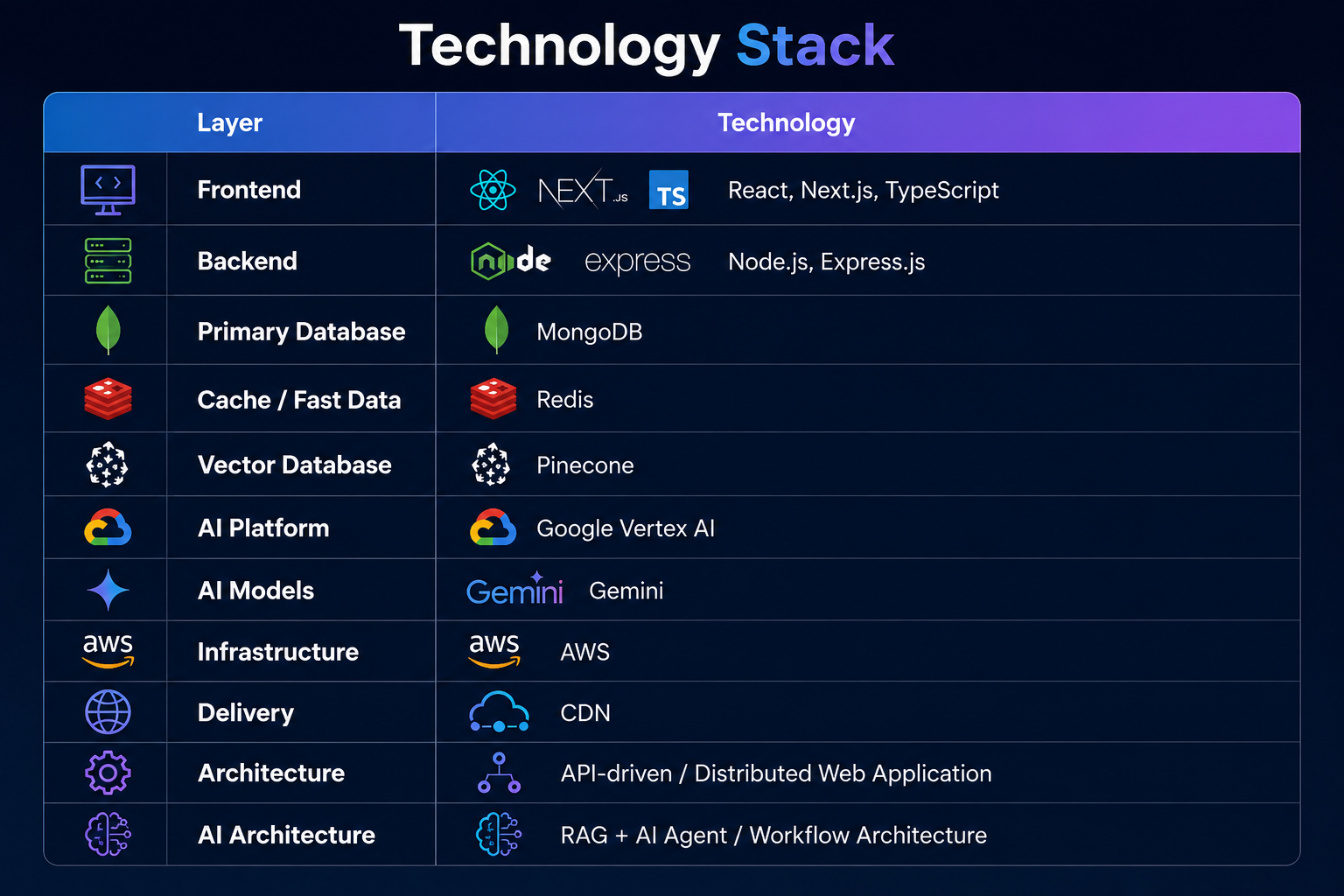
Core Technical Architecture
Zuvany is built as a distributed web application combining traditional web technologies with AI infrastructure.
Frontend
- React
- Next.js
- TypeScript
- Responsive UI
- Dynamic chatbot configuration
- Real-time conversation interface
- Analytics dashboards
- Business management interface
Backend
- Node.js
- Express.js
- REST APIs
- Authentication and authorization
- Conversation management
- Lead management
- AI orchestration
- Workflow execution
- Website crawling services
- Knowledge ingestion pipelines
Data Layer
- MongoDB — primary application database
- Redis — caching, temporary state, performance optimization, and conversational infrastructure
- Pinecone — vector database for semantic knowledge retrieval
AI Infrastructure
- Google Vertex AI
- Gemini models
- Retrieval-Augmented Generation (RAG)
- Embedding-based semantic search
- Prompt orchestration
- AI tool/action execution
Infrastructure
- AWS
- CDN-based chatbot delivery
- Scalable backend services
- Background processing
- API-driven architecture
AI Knowledge Training Pipeline
One of the important engineering components of Zuvany is the knowledge ingestion pipeline.
Businesses can provide knowledge through multiple sources:
Website → PDF → Text → Business Knowledge
The system processes the input, extracts meaningful content, structures the information, generates embeddings, and stores the resulting vectors in Pinecone.
During a customer conversation, the system retrieves the most relevant knowledge and provides it to the AI model as contextual information.
A simplified flow is:
Business Data
     ↓
Content Ingestion
     ↓
Content Processing
     ↓
Chunking / Structuring
     ↓
Embedding Generation
     ↓
Pinecone Vector Database
     ↓
Semantic Retrieval
     ↓
Relevant Context
     ↓
Gemini / Vertex AI
     ↓
AI Response
This allows the assistant to answer questions based on the business's own knowledge rather than relying only on general-purpose model knowledge.
Website Crawler
I built a dedicated website crawler for Zuvany.
The crawler is designed to understand a website as a collection of structured pages rather than simply downloading HTML.
It can:
- Discover website pages
- Follow internal links
- Process individual pages
- Extract meaningful content
- Remove unnecessary page elements
- Structure page information
- Prepare content for AI ingestion
- Build a searchable knowledge base
The crawler is particularly important because businesses often have large websites containing product pages, documentation, FAQs, service pages, pricing information, policies, and other content.
Instead of requiring businesses to manually copy this information, Zuvany can automatically crawl and prepare the website content for AI training.
RAG-Based Question Answering
Zuvany uses a Retrieval-Augmented Generation architecture.
When a customer asks a question, the system does not blindly send the question directly to the LLM.
Instead, the pipeline performs retrieval first.
Customer Question
       ↓
Question Processing
       ↓
Embedding / Semantic Search
       ↓
Pinecone
       ↓
Relevant Knowledge
       ↓
Context Construction
       ↓
Gemini
       ↓
Validated AI Response
       ↓
Customer
This architecture helps the AI assistant ground its responses in the business's own knowledge.
Intelligent Lead Collection
Zuvany is not designed to behave like a traditional contact form.
Lead collection happens naturally inside the conversation.
For example, when a customer demonstrates buying intent, the assistant can collect relevant information such as:
- Name
- Phone number
- Company
- Requirements
- Other business-specific information
The goal is to make lead generation part of the conversation rather than interrupting the user experience with a separate form.
Meeting Booking
The AI assistant can also assist customers in booking meetings.
The conversational flow can identify meeting intent and guide the customer through the required information.
This allows the website assistant to move from:
Question → Conversation → Qualification → Meeting
instead of simply:
Question → Answer
AI Action Workflows
One of the more advanced parts of Zuvany is its action/workflow system.
Businesses can define actions that the AI should perform.
For example:
Customer:
"I want to report a complaint."

        ↓

AI identifies intent

        ↓

Complaint Workflow

        ↓

Collect required information

        ↓

Validate information

        ↓

Execute business action

        ↓

Create complaint / ticket
This architecture allows Zuvany to move toward AI agents that can perform business operations, rather than being limited to question answering.
Possible workflows include:
- Complaint registration
- Ticket creation
- Lead creation
- Appointment requests
- Information collection
- Business-specific API actions
- Internal workflow execution
Multilingual AI Conversations
Zuvany supports multilingual conversations.
A visitor can communicate with the assistant in their preferred language, and the AI can respond in the same language.
The system therefore does not require businesses to create a separate chatbot for every language.
The conversational layer dynamically handles the user's language while maintaining the relevant business context.
Fully Customizable Chatbot
The chatbot widget is designed as a configurable frontend component rather than a fixed UI.
Businesses can customize:
- Colors
- Theme
- Branding
- Welcome message
- Assistant identity
- Content
- Chat appearance
- Widget behavior
- Other UI configurations
The same underlying AI infrastructure can therefore power assistants with completely different visual identities.
CDN-Based Integration
One of the key product decisions was making Zuvany extremely easy to integrate.
A business does not need to install a large SDK or modify its backend.
The website can integrate the chatbot using a small JavaScript snippet delivered through Zuvany's CDN.
Conceptually:
Business Website
       │
       │  Small JS Snippet
       ↓
    Zuvany CDN
       ↓
   Chatbot Widget
       ↓
   Zuvany APIs
       ↓
AI / Knowledge / Workflow Systems
This makes the integration platform-independent.
The same integration approach can work with:
- Custom websites
- React applications
- Next.js applications
- WordPress
- Wix
- Other website platforms
The objective is to make the integration essentially copy → paste → configure.
All-in-One Conversation Inbox
Zuvany provides a centralized inbox where businesses can see customer conversations.
The inbox provides visibility into:
- Customer conversations
- Conversation history
- Lead interactions
- AI responses
- Customer questions
- Unresolved questions
- Conversation context
This creates a bridge between AI automation and human support.
Businesses can review conversations instead of treating the AI assistant as a black box.
Auto Training / Knowledge Gap Detection
Another important capability is identifying questions that the AI could not confidently answer.
When a customer asks something outside the assistant's available knowledge, Zuvany can identify that knowledge gap.
Instead of silently losing the question, the platform surfaces it for the business.
For example:
Customer Question
       ↓
AI cannot confidently answer
       ↓
Knowledge Gap Detected
       ↓
Question appears in Dashboard
       ↓
Business Employee provides answer
       ↓
Knowledge updated
       ↓
Future customers can receive the answer
This creates a feedback loop where the knowledge base can continuously improve based on real customer conversations.
Analytics
Zuvany includes analytics for understanding how customers interact with the AI assistant.
The analytics layer can provide insights around:
- Conversations
- Messages
- Usage
- Customer interactions
- Leads
- Engagement
- Chatbot activity
- Frequently asked questions
- Unanswered questions
- Conversion-related activity
The objective is not only to provide an AI chatbot, but also to provide businesses with visibility into how their customers are using it.
Shareable AI Assistants
Each Zuvany assistant can also have a shareable conversational interface.
This allows businesses to provide a direct link to their AI assistant without requiring the visitor to access the original website.
This is useful for:
- Sharing an AI assistant directly
- Customer support
- Product information
- Internal demonstrations
- Campaigns
- Testing AI knowledge
Engineering Challenges
Building Zuvany involved solving several engineering problems beyond simply connecting an application to an LLM.
1. Knowledge ingestion
Different sources have different structures and quality.
Website HTML, PDFs, and manually entered text need to be transformed into a consistent knowledge representation before they can be used by the AI.
2. Retrieval quality
The system needs to retrieve relevant information rather than simply performing keyword matching.
Semantic search and vector retrieval are therefore important parts of the architecture.
3. AI reliability
The system needs to distinguish between:
- Known information
- Relevant information
- Missing information
- Low-confidence situations
This is particularly important when the AI represents a business.
4. Conversational state
AI conversations require context management across multiple messages while maintaining performance and controlling the amount of information sent to the model.
5. AI actions
Moving from:
"AI generates text"
to:
"AI performs an operation"
requires additional orchestration, validation, state management, and execution logic.
6. Embeddable architecture
The chatbot must work across different websites without requiring businesses to change their existing technology stack.
7. Scalability
The architecture needs to support potentially large numbers of independent businesses, assistants, conversations, documents, and AI requests while keeping tenants isolated.
Technology Stack
My Role
I am responsible for the end-to-end development of Zuvany.
My responsibilities include:
- System architecture
- Frontend development
- Backend development
- API design
- Database architecture
- Redis-based infrastructure
- AI integration
- RAG pipeline
- Vector search architecture
- Website crawler
- Knowledge ingestion
- AI workflow architecture
- Chatbot widget
- CDN integration
- Analytics
- Conversation management
- Lead management
- Infrastructure and deployment
The project gave me hands-on experience building a production-oriented AI platform rather than simply integrating an LLM API into an existing application.
What Zuvany Represents Technically
Zuvany is a combination of several engineering domains:
ZUVANI
                       │
        ┌──────────────┼──────────────┐
        ↓              ↓              ↓
   Web Platform     AI Platform    Data Platform
        │              │              │
   React/Next.js    Gemini/RAG     MongoDB
   Chat Widget     Pinecone       Redis
   CDN             AI Actions     Vector Search
        │              │              │
        └──────────────┼──────────────┘
                       ↓
                Business Automation
                       │
          ┌────────────┼────────────┐
          ↓            ↓            ↓
       Leads       Meetings      Workflows
          │            │            │
          └────────────┼────────────┘
                       ↓
                Customer Experience
The project demonstrates my ability to work across the full stack—from browser-level UI and embeddable JavaScript components to backend APIs, distributed data systems, AI pipelines, vector databases, workflow execution, and cloud infrastructure.
Key Engineering Capabilities Demonstrated
Full-Stack Engineering Designing and implementing both frontend and backend systems.
AI Engineering Building LLM-powered applications using Gemini, Vertex AI, RAG, embeddings, semantic retrieval, and AI actions.
Distributed Systems Working with multiple services and infrastructure components including APIs, databases, Redis, vector storage, CDN delivery, and background processing.
Data Engineering Building pipelines that transform websites, documents, and business information into AI-consumable knowledge.
System Design Designing a multi-tenant platform where independent businesses can create and operate their own AI assistants.
Integration Engineering Building a platform-independent chatbot that can be embedded into different website technologies.
Product Engineering Taking an AI concept from architecture through implementation into a complete usable platform.
Final Perspective
Zuvany started as an AI chatbot concept, but technically it evolved into a broader AI application platform.
The core challenge was not simply making an LLM answer questions.
The real engineering problem was building the infrastructure around the model:
How do we ingest business knowledge? How do we retrieve the right information? How do we maintain conversation context? How do we detect missing knowledge? How do we allow AI to execute actions? How do we embed the system into any website? How do we observe and analyze conversations? How do we make all of this scalable for multiple businesses?
Zuvany is my implementation of that complete system—from the user-facing chatbot to the AI orchestration and underlying infrastructure.